
PCOS and the Microbiome: A Root-Cause Approach to Hormonal Balance
By Dr. Chomba Chuma, MD & Founder of Her-Biotics | September 18, 2026
If you have been diagnosed with PCOS — polycystic ovary syndrome — you have probably been told it is a hormonal condition. And that is true. But it is also a metabolic condition, an inflammatory condition, and increasingly, scientists are recognising it as a gut condition. That last part tends to surprise people. But when you understand how intimately your gut bacteria communicate with your ovaries, your insulin receptors, and your stress response, it starts to make profound sense.
PCOS affects an estimated 1 in 10 women of reproductive age worldwide, making it the most common endocrine disorder in women. Yet despite its prevalence, many women spend years cycling through symptom management — birth control for irregular periods, metformin for insulin resistance, spironolactone for acne and hair loss — without anyone ever asking: why is this happening in the first place?
This article is about that question. It is about root causes. And the emerging science of the microbiome is giving us some of the most compelling answers we have seen in decades.
What Is PCOS, Really? Beyond the Textbook Definition
Most clinical definitions of PCOS focus on three diagnostic criteria, often called the Rotterdam criteria:
- Irregular or absent ovulation (oligo- or anovulation)
- Elevated androgens — either clinically (acne, hirsutism, hair thinning) or biochemically (high testosterone, DHEA-S)
- Polycystic ovarian morphology on ultrasound
You need at least two of three to receive a diagnosis. But here is what those criteria do not tell you: PCOS is extraordinarily heterogeneous. Two women with identical diagnoses can have completely different underlying drivers. One may have severe insulin resistance; another may have lean PCOS with predominantly inflammatory features; a third may have a strong adrenal component.
This heterogeneity is exactly why a one-size-fits-all treatment approach so often fails — and why understanding root causes matters so much.
The Four Core Dysfunctions in PCOS
While presentations vary, most cases of PCOS involve some combination of:
- Insulin resistance — present in up to 70–80% of women with PCOS, regardless of body weight
- Chronic low-grade inflammation — elevated CRP, IL-6, TNF-alpha
- HPA axis dysregulation — elevated cortisol and adrenal androgens
- Gut dysbiosis — altered composition and function of the gut microbiome
That fourth driver is where I want to spend most of our time today, because it is the one most frequently overlooked — and the one most amenable to targeted nutritional intervention.
The Gut-Hormone Axis: How Your Microbiome Shapes Your Hormones
Your gut is home to approximately 38 trillion microbial cells — bacteria, fungi, archaea, and viruses — that collectively perform metabolic functions your own human cells simply cannot. Among those functions is the regulation of your hormonal environment.
Here is how it works:
The Estrobolome: Your Gut's Oestrogen Regulator
A specific collection of gut bacteria — collectively called the estrobolome — produces an enzyme called beta-glucuronidase. This enzyme deconjugates oestrogens in the gut, determining how much oestrogen is reabsorbed into circulation versus excreted in faeces.
When the estrobolome is dysbiotic (imbalanced), beta-glucuronidase activity can go awry in either direction:
- Too much activity → excess oestrogen recirculates → oestrogen dominance, worsening androgen-to-oestrogen imbalance
- Too little activity → insufficient oestrogen → disrupted follicular development
In PCOS specifically, research has shown that women have a significantly altered estrobolome compared to healthy controls, with downstream effects on the oestrogen-to-progesterone ratio that drives cycle irregularity.
Gut Bacteria and Androgen Metabolism
It is not just oestrogen. Gut bacteria also influence androgen metabolism. Certain bacterial species produce enzymes that can activate androgen precursors — meaning a dysbiotic gut can effectively amplify androgenic signalling even when ovarian androgen production is only mildly elevated.
Key finding: A landmark 2019 study published in the Journal of Clinical Endocrinology & Metabolism found that women with PCOS had significantly lower levels of Lactobacillus species and higher levels of pro-inflammatory bacteria compared to healthy controls — a pattern directly correlated with higher free androgen index scores. Read the study
Insulin Resistance, Gut Permeability, and the PCOS Feedback Loop
Of all the mechanisms linking the microbiome to PCOS, the insulin resistance pathway is the most well-established and arguably the most clinically significant.
Leaky Gut as an Upstream Driver
Dysbiosis — an imbalance in the ratio of beneficial to harmful gut bacteria — disrupts the integrity of the intestinal epithelial barrier. When tight junctions between gut cells loosen, the result is increased intestinal permeability, colloquially known as "leaky gut."
This allows lipopolysaccharides (LPS) — fragments of the outer membrane of gram-negative bacteria — to cross the gut barrier and enter systemic circulation. LPS is a potent endotoxin, and even low levels of circulating LPS trigger a systemic inflammatory response.
Here is where it gets directly relevant to PCOS:
- LPS activates toll-like receptor 4 (TLR4) on immune and metabolic cells
- TLR4 activation impairs insulin signalling at the cellular level
- Impaired insulin signalling → insulin resistance → compensatory hyperinsulinaemia
- Elevated insulin stimulates the ovaries to produce more androgens (via LH-mediated theca cell stimulation)
- Excess androgens disrupt follicular development → anovulation → irregular cycles
This is a self-reinforcing loop. Gut dysbiosis drives insulin resistance, which drives androgen excess, which further disrupts the hormonal environment — including the gut's own hormonal regulation.
Research highlight: A 2021 meta-analysis in Frontiers in Endocrinology confirmed that women with PCOS show significantly elevated serum LPS levels compared to healthy controls, and that LPS levels correlate positively with both HOMA-IR (a measure of insulin resistance) and free testosterone. Read the meta-analysis
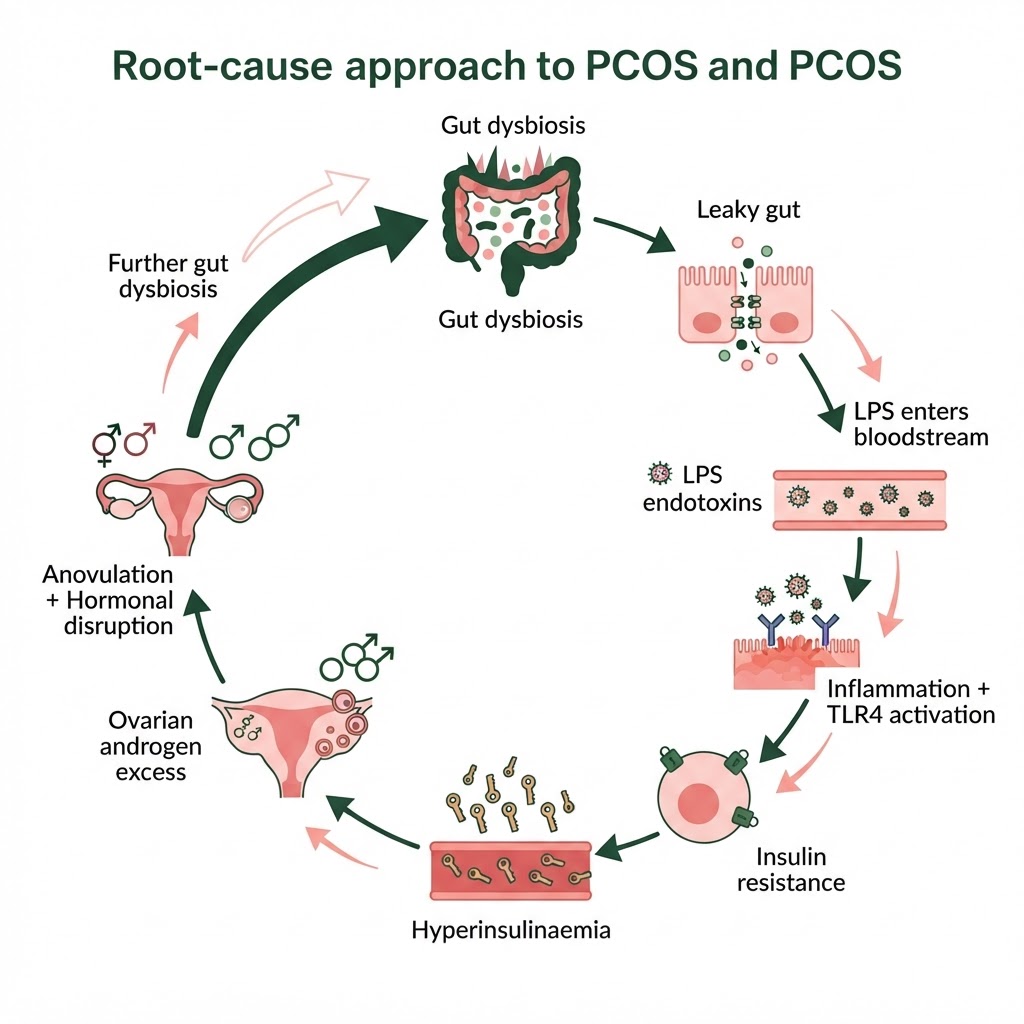 Figure: A circular diagram showing the PCOS-gut dysbiosis feedback loop: Gut dysbiosis → Leaky gut → LPS enters bloodstream → Inflammation + TLR4 activation → Insulin resistance → Hyperinsulinaemia → Ovarian androgen excess → Anovulation + Hormonal disruption → Further gut dysbiosis. Include icons for each step and use brand colour palette.
Short-Chain Fatty Acids and Insulin Sensitivity
On the flip side, a healthy, diverse microbiome produces short-chain fatty acids (SCFAs) — including butyrate, propionate, and acetate — through the fermentation of dietary fibre. SCFAs:
- Strengthen the gut barrier, reducing LPS translocation
- Activate GLP-1 and PYY receptors, improving insulin sensitivity
- Reduce hepatic glucose production, lowering fasting insulin
- Suppress NFκB-mediated inflammation
Women with PCOS consistently show reduced SCFA-producing bacteria, particularly species like Faecalibacterium prausnitzii, Roseburia intestinalis, and Akkermansia muciniphila. Restoring these populations is a meaningful therapeutic target.
The Evidence for Probiotics in PCOS Management
Given this mechanistic framework, the question becomes: can probiotics for PCOS make a measurable clinical difference? The evidence is growing — and it is genuinely exciting.
Clinical Trials: What the Data Show
Several well-designed randomised controlled trials have now examined probiotic supplementation in women with PCOS:
Insulin and metabolic markers: A 2017 RCT published in the Journal of Functional Foods found that 12 weeks of multi-strain probiotic supplementation significantly reduced fasting insulin, HOMA-IR, and triglycerides in women with PCOS compared to placebo. The probiotic group also showed improvements in BMI and waist circumference.
Androgen levels: A 2020 RCT found that women with PCOS receiving a combined probiotic-prebiotic supplement for 12 weeks experienced significant reductions in total testosterone and free androgen index, alongside improvements in menstrual regularity.
Inflammatory markers: Multiple studies have documented reductions in CRP, IL-6, and MDA (malondialdehyde — a marker of oxidative stress) following probiotic intervention in PCOS populations.
Mood and quality of life: Given the gut-brain axis, it is perhaps unsurprising that probiotic supplementation has also been associated with improvements in depression scores and anxiety in women with PCOS — a population with significantly elevated rates of both.
Which Strains Matter Most?
Not all probiotics are created equal, and strain specificity matters enormously. The most evidence-backed strains for PCOS-related outcomes include:
- Lactobacillus acidophilus — improves insulin sensitivity, reduces LPS translocation
- Lactobacillus rhamnosus — modulates cortisol and HPA axis activity
- Bifidobacterium longum — reduces systemic inflammation, supports oestrogen metabolism
- Lactobacillus reuteri — shown to reduce LH:FSH ratio and improve ovarian morphology in animal models
- Bifidobacterium lactis — enhances gut barrier integrity, reduces endotoxaemia
This is precisely why multi-strain formulations with clinically relevant doses tend to outperform single-strain products in PCOS research — different strains act on different nodes of the dysbiosis-PCOS loop simultaneously.
Why Delivery Technology Is the Missing Piece
Here is something the probiotic industry does not talk about enough: most probiotics do not survive the journey to your gut.
Standard probiotic capsules must withstand stomach acid (pH 1.5–3.5), bile salts, and digestive enzymes before reaching the colon — where most of their therapeutic work occurs. Studies suggest that conventional probiotic formulations lose 90–99% of their viable bacteria between manufacture and delivery to the large intestine.
This is why at Her-Biotics, we developed our patented SCO2 (supercritical carbon dioxide) microencapsulation technology. Each bacterial strain is individually encapsulated in a lipid-polymer matrix using supercritical CO2 — a process that:
- Preserves viability across manufacturing, storage, and transit through the GI tract
- Delivers a targeted, time-released dissolution in the colon, where it matters most
- Achieves 1000× more viable bacteria reaching the gut compared to standard unencapsulated supplements
For women with PCOS, where the therapeutic target is genuine microbiome restoration rather than temporary colonisation, this level of delivery precision is not a luxury — it is a necessity. You can read more about the technology on our Science Page.
A Root-Cause Protocol: What to Actually Do
Understanding the science is empowering. But I also want to leave you with a practical framework — because knowledge without action is just information.
1. Address Gut Dysbiosis Directly
This means a high-quality, multi-strain probiotic with proven delivery technology taken consistently. For most women with PCOS, I recommend at least 12 weeks of daily supplementation before assessing outcomes — microbiome change takes time.
2. Feed Your Good Bacteria
Probiotics work best alongside prebiotic fibres that feed beneficial strains. Focus on:
- Jerusalem artichokes, leeks, onions, garlic (inulin and FOS)
- Green bananas and cooled cooked potatoes (resistant starch)
- Diverse vegetables and legumes (mixed fermentable fibres)
3. Reduce the Drivers of Dysbiosis
The most common microbiome disruptors in women with PCOS include:
- Ultra-processed foods and added sugars — feed pathogenic bacteria and worsen insulin resistance
- Chronic psychological stress — alters gut motility and microbiome composition via the HPA-gut axis
- Unnecessary antibiotic exposure — causes lasting reductions in microbial diversity
- Poor sleep — even one night of sleep disruption measurably alters gut microbiome composition
4. Support the Broader Hormonal Ecosystem
The microbiome does not operate in isolation. Complementary interventions with good evidence in PCOS include:
- Magnesium glycinate — improves insulin sensitivity and reduces cortisol
- Inositol (myo- and D-chiro) — improves ovarian response to insulin, supports ovulation
- Zinc — reduces 5-alpha reductase activity, lowering DHT conversion
- Vitamin D3 — deficiency is near-universal in PCOS and independently worsens insulin resistance
- Chasteberry (Vitex agnus-castus) — supports LH regulation and progesterone balance
You can explore our full evidence base for these ingredients across the Her-Biotics formula range or dive deeper into the clinical research on our Radiance Hub.
The Bigger Picture: PCOS as a Systems Condition
I want to close with something I tell every patient I work with who has a PCOS diagnosis: this condition is not your fault, and it is not a life sentence.
PCOS emerged — evolutionarily and individually — from the intersection of genetics, environment, nutrition, stress, and the invisible ecosystem living inside your gut. That means it is profoundly responsive to the signals you send your body every day. Every meal, every night of sleep, every targeted supplement is a message to your microbiome and your hormonal system.
The research on gut bacteria, insulin resistance, hormones, and the microbiome in PCOS is still evolving — but what we already know is enough to act on. We do not need perfect certainty to begin supporting the root causes. We need a framework, some patience, and the right tools.
Your gut is not a side character in your PCOS story. It may well be the lead.
Ready to Start at the Root?
If you are living with PCOS and ready to take a microbiome-first approach, Her-Biotics Original was formulated specifically with multi-system support in mind. Its 16-strain SCO2-encapsulated probiotic blend — combined with Vitamin C, E, B-vitamins, and Zinc — targets gut barrier integrity, inflammation, and hormonal metabolism simultaneously. And for women whose PCOS is accompanied by cycle irregularity and PMS symptoms, Her-Biotics PMS Support adds Chasteberry, Magnesium Glycinate, and Evening Primrose Oil to the foundational probiotic stack — addressing the hormonal disruption that often sits downstream of gut dysfunction. Because you deserve a supplement that works as hard as the science behind it. Explore all formulas and find the right fit for where you are right now.
Dr. Chomba Chuma is a medical doctor and the founder of Her-Biotics. This article is for informational purposes only and does not constitute medical advice. Always consult a qualified healthcare provider before beginning any new supplement regimen, particularly if you have a diagnosed medical condition.