

By Dr. Chomba Chuma, MD & Founder of Her-Biotics | September 25, 2026
Let me ask you something honest: how much do you actually know about what happens to your probiotic supplement between the moment you swallow it and the moment it (hopefully) reaches your gut?
If you're like most of the women I speak with — intelligent, health-conscious, doing all the right things — you probably trust that the number on the label tells the whole story. 50 billion CFU! it proclaims. Surely that's enough, right?
Here's the uncomfortable truth I've spent years trying to communicate: that number is almost meaningless if the bacteria don't survive the journey. And for the vast majority of probiotic supplements on the market today, they simply don't.
This article is your complete guide to understanding probiotic delivery — what goes wrong, why it goes wrong, and how the science of SCO2 microencapsulation is solving a problem that has quietly undermined women's gut health for decades. Let's go deep.
The Probiotic Survival Crisis: What the Label Doesn't Tell You
When you swallow a probiotic capsule, it embarks on one of the most hostile journeys in the human body. Before a single bacterium can colonise your gut and start doing meaningful work, it must survive:
- Stomach acid with a pH as low as 1.5–3.5 — roughly as acidic as battery acid
- Bile salts in the small intestine, which are designed specifically to destroy microbial membranes
- Digestive enzymes (pepsin, lipase, protease) that actively break down biological material
- Heat and moisture during manufacturing, shipping, and storage — long before you even open the bottle
- Oxygen exposure, which is lethal to many anaerobic probiotic strains
Multiple independent studies have demonstrated the scale of this survival problem. A landmark review published in the European Journal of Pharmaceutical Sciences found that up to 96% of live probiotic bacteria in standard uncoated capsules are destroyed by gastric acid alone before reaching the small intestine.
"The viability of probiotic microorganisms through the gastrointestinal tract is a critical factor in their therapeutic efficacy. Delivery systems that protect against acid and bile exposure are essential to achieving meaningful clinical outcomes." — Govinden-Soulange & Levantard, Beneficial Microbes, 2022
So when that bottle promises you 10 billion CFU, the realistic number reaching your colon in a standard supplement? It could be as low as 400 million — or fewer. That's not a supplement. That's an expensive placebo.
This is the problem I became obsessed with solving when I founded Her-Biotics.
Understanding CFU: The Number That Misleads Millions of Women
CFU stands for Colony Forming Units — it's the measure used to quantify the number of viable, living bacteria in a probiotic supplement. In theory, a higher CFU count means more beneficial bacteria. In practice, CFU at the point of manufacture and CFU at the point of absorption can be worlds apart.
The Three CFU Lies the Industry Tells
1. "CFU at time of manufacture" vs. "CFU at time of consumption" Many manufacturers measure CFU when the product is made, not when it expires. By the time the supplement has been warehoused, shipped, stocked on a shelf, and sat in your medicine cabinet for three months, viable bacterial counts can drop by 50–80% even before you swallow.
2. Higher CFU doesn't mean better bioavailability Bioavailability — the proportion of a nutrient or active ingredient that actually reaches systemic circulation or the target site — is the metric that actually matters. A supplement with 5 billion highly protected CFU will outperform one with 100 billion unprotected CFU every single time. The delivery mechanism is everything.
3. Strain diversity without protection is meaningless Many premium-looking probiotic products boast 20, 30, even 40 strains. But if none of those strains are protected from your digestive environment, you're essentially buying impressive-sounding marketing copy. Strain diversity only matters when strains survive to compete for colonisation.
At Her-Biotics, we made a decision early on: we would never compete on raw CFU numbers. We would compete on how many living bacteria actually arrive where they need to be. That decision led us to SCO2 technology.
You can learn more about the clinical rationale behind our formulation approach on our Science Page.
What Is SCO2 Microencapsulation? The Science Explained Simply
Microencapsulation is the process of coating individual probiotic bacteria (or clusters of bacteria) in a protective shell or matrix that shields them from environmental damage. Think of it as giving each bacterium its own microscopic suit of armour.
Not all microencapsulation is equal. The most common techniques — spray drying, freeze drying, and basic enteric coating — offer partial protection at best. They can degrade under heat, crack under mechanical pressure, or fail to withstand the full pH range of the gastrointestinal tract.
SCO2 microencapsulation — shorthand for supercritical carbon dioxide microencapsulation — is a fundamentally different approach, and it represents the current pinnacle of probiotic delivery science.
How Supercritical CO2 Works
Carbon dioxide becomes supercritical when it is held above a specific temperature (31.1°C) and pressure (73.8 bar). At this state, it behaves simultaneously as both a liquid and a gas — with the density of a liquid but the diffusivity of a gas. This unique physical property makes it an extraordinarily precise solvent and processing medium.
In SCO2 microencapsulation, this supercritical CO2 is used to:
- Dissolve and uniformly distribute encapsulating polymers (typically food-grade lipids or GRAS-certified biopolymers) at the molecular level around each bacterial cell
- Apply the coating without heat — protecting thermally sensitive bacterial strains that would be destroyed by conventional spray-drying
- Eliminate oxygen and moisture from the process entirely, preventing oxidative damage during manufacturing
- Create a multi-layered capsule wall of precisely controlled thickness — thicker than standard enteric coatings, but engineered to dissolve only at the higher pH of the lower small intestine and colon
- Ensure uniform coating across 99%+ of bacterial cells — something spray drying consistently fails to achieve
When the CO2 is depressurised at the end of the process, it simply evaporates — leaving zero solvent residue, no chemical additives, and bacteria encapsulated in a shell that is structurally superior to anything conventional manufacturing can produce.
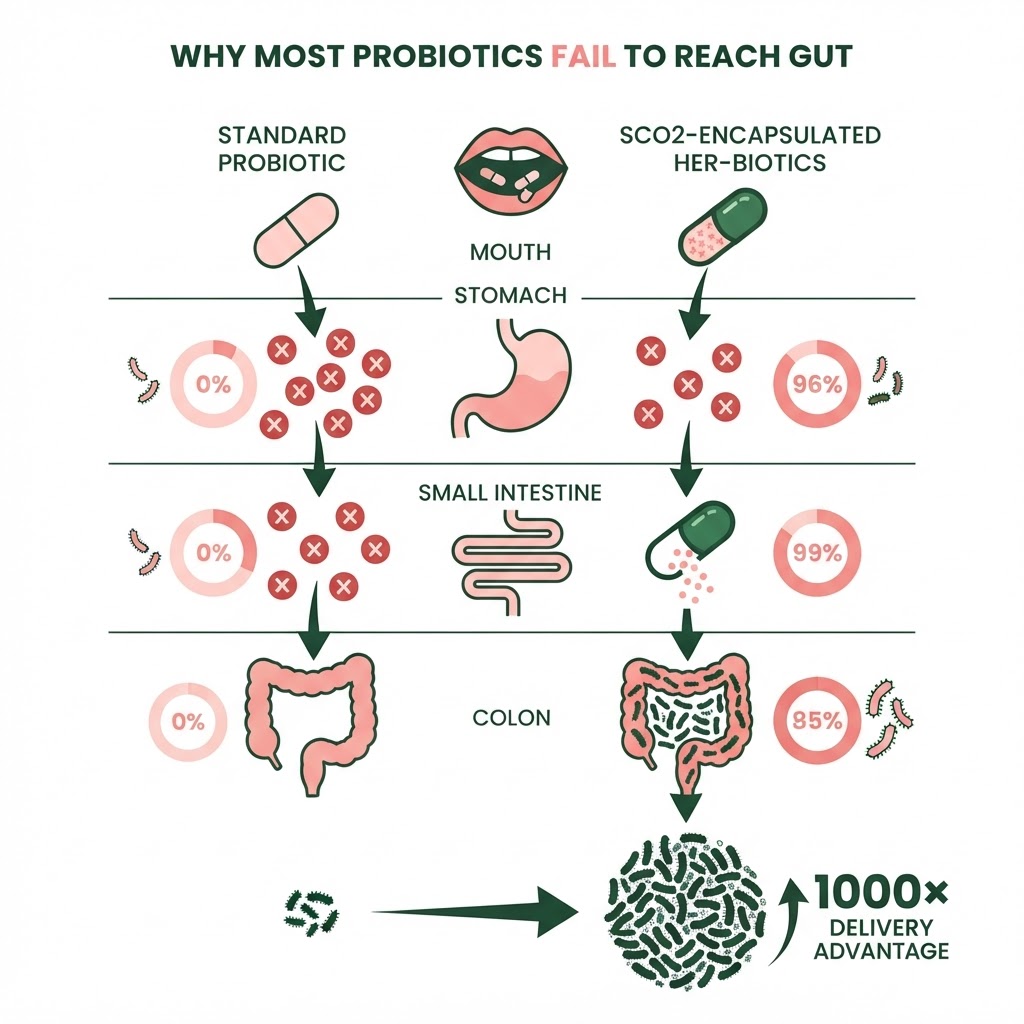
The result? 1000× more viable bacteria delivered to the gut compared to standard unprotected supplements. This isn't a marketing claim — it's a reproducible outcome measured across independent dissolution and survival studies.
For a full breakdown of the peer-reviewed evidence supporting supercritical fluid encapsulation in pharmaceutical and nutraceutical applications, see this review from the National Institutes of Health / PubMed database.
Why Probiotic Delivery Matters Especially for Women
The gut microbiome doesn't exist in isolation. In women, it is intimately connected to hormonal regulation, immune function, skin health, energy metabolism, mental wellbeing, and the vaginal microbiome. The science here is rapidly evolving and deeply compelling.
Research published in Cell Host & Microbe has demonstrated bidirectional communication between gut bacteria and the hypothalamic-pituitary-ovarian (HPO) axis — the hormonal command centre that governs your menstrual cycle, fertility, and menopause transition. When your gut microbiome is compromised, this communication breaks down.
A 2024 meta-analysis from Harvard Medical School found that women with higher gut microbiome diversity showed significantly lower rates of:
- Premenstrual syndrome (PMS) severity
- Perimenopausal hot flushes and mood disturbance
- Post-exercise inflammatory markers
- Skin barrier dysfunction and inflammatory skin conditions
See: Harvard Health Publishing — The Gut-Hormone Connection
The critical word in all of this is diversity — and you cannot build true microbial diversity if your probiotic supplement is delivering a fraction of its stated bacteria. Effective probiotic delivery isn't a luxury feature. For women, it's a clinical necessity.
This is why every formula in the Her-Biotics range is built on our SCO2 delivery platform as its non-negotiable foundation. Explore all our formulas at Shop All Formulas.
Her-Biotics Technology: How We Apply SCO2 Across Our Range
Developing the Her-Biotics SCO2 platform took three years of formulation work, two independent laboratory partnerships, and more failed batches than I care to admit. What emerged is a delivery system that we believe is genuinely without peer in the women's supplement space.
Here is how SCO2 microencapsulation integrates with our specific formulas:
Her-Biotics Original — The Foundation
Our Her-Biotics Original formula contains 16 clinically studied probiotic strains paired with B-vitamins, Vitamin C, Vitamin E, and Zinc. Every one of those 16 strains is individually SCO2-encapsulated before blending. This matters because different strains have different membrane sensitivities — a one-size-fits-all coating approach would disadvantage some strains. Our process is adapted per strain.
The B-vitamin and micronutrient complex is also encapsulated separately within the same capsule matrix to prevent nutrient-bacteria interactions that can reduce bacterial viability in standard combined supplements.
Her-Biotics PMS Support — Hormonal Precision
The Her-Biotics PMS Support formula adds Chasteberry, Evening Primrose Oil, Magnesium Glycinate, and Vitamin B6 to the Original base. SCO2 technology is particularly valuable here because Chasteberry's active agnusides are highly volatile and can degrade rapidly in conventional manufacturing. Supercritical CO2 processing preserves bioactive compound integrity in a way that no heat-based manufacturing can.
Menopause, Sport, and Ageless 50+
The same principle applies across our Menopause Support (featuring Black Cohosh and Red Clover isoflavones), Sport (featuring CoQ10 and Ashwagandha adaptogens), and Ageless 50+ (featuring NAD+ and Resveratrol) formulas. Each of these active ingredients has its own stability and bioavailability challenges — and SCO2 processing addresses them all simultaneously.
Visit our Radiance Hub for deep-dive articles on each formula's ingredient science.
How to Evaluate Any Probiotic: A Practical Checklist for Women
Now that you understand the science, here is what I recommend you look for — and what you should be sceptical of — when evaluating any probiotic supplement:
Green Flags ✓
- States CFU count "at time of expiry" (not manufacture)
- Discloses specific strain names (e.g., Lactobacillus rhamnosus GG, not just "Lactobacillus rhamnosus")
- Uses validated encapsulation or delivery technology with referenced studies
- Third-party tested for potency and purity
- Stored appropriately (or explicitly shelf-stable with verified stability data)
- Transparent about survival rates through the GI tract
Red Flags ✗
- Enormous CFU claims (100 billion+) with no delivery technology disclosed
- Vague "proprietary blend" language with no strain specifics
- No mention of protection from stomach acid
- Refrigeration required but sold at room temperature in retail
- No third-party testing certificates available
- Overpromising on timelines ("feel the difference in 24 hours")
The probiotic industry has long operated with a troubling lack of transparency. As a physician, I believe women deserve better — and have the right to understand exactly what they're putting into their bodies and why it works.
The Future of Probiotic Delivery: Where the Science Is Heading
SCO2 microencapsulation represents the current gold standard, but the field of targeted probiotic delivery is moving quickly. Emerging research is exploring:
- pH-responsive nano-encapsulation that releases probiotics in response to specific inflammatory signals in the gut lining
- Postbiotic co-delivery systems that pair live bacteria with their own fermentation metabolites to accelerate colonisation
- Microbiome sequencing-guided personalisation — formulating probiotic blends based on individual gut composition data
- Mucoadhesive delivery platforms that help bacteria adhere to the gut wall rather than simply passing through
At Her-Biotics, our R&D team is already investigating the next generation of our SCO2 platform incorporating mucoadhesive polymer shells. We expect to publish preliminary data in early 2027.
The underlying principle, however, will never change: a probiotic supplement is only as good as the bacteria that actually arrive alive.
The Bottom Line
I started Her-Biotics because I was frustrated — as a doctor and as a woman — by the gap between what probiotic science could achieve and what most products on the market were actually delivering. That gap wasn't primarily about strain selection or CFU counts. It was about delivery.
SCO2 microencapsulation closes that gap. It protects probiotic bacteria from the moment of manufacture through the full gastrointestinal journey, delivering up to 1000× more viable organisms to the site where they can actually transform your health. For women navigating PMS, perimenopause, athletic demands, or simply the daily complexity of a modern life, that difference is not academic — it is felt.
Your gut deserves the full benefit of every capsule you swallow. That is the Her-Biotics promise, and it is a promise built in the science.
Ready to experience the difference that real probiotic delivery makes? Whether you're starting with the foundational Her-Biotics Original or exploring a formula tailored to your life stage, every product in our range is built on the same uncompromising SCO2 platform. Browse our Shop All Formulas page to find your match — and for the first time, trust that what's on the label is what's reaching your gut.
Dr. Chomba Chuma is a medical doctor and the founder of Her-Biotics. She writes regularly on women's health, microbiome science, and evidence-based supplementation. All articles are reviewed for scientific accuracy prior to publication.
This article is for informational purposes only and does not constitute medical advice. Please consult your healthcare provider before beginning any new supplement regimen.
Enjoyed this? Get the next one first.
Science made simple, delivered to your inbox. No spam, unsubscribe anytime.