

By Dr. Chomba Chuma, MD & Founder of Her-Biotics | August 5, 2026
If you've spent years layering on serums, switching cleansers, and eliminating foods from your diet — only to still wake up to inflamed skin — I want you to take a deep breath. You haven't been failing. You've simply been working from the outside in, when the most transformative answers are waiting inside your gut.
As a physician and the founder of Her-Biotics, I've spent over a decade sitting across from women who are frustrated, exhausted, and frankly, emotionally depleted by chronic skin conditions. What I've come to understand — and what an exciting and rapidly growing body of research now confirms — is that your gut and your skin are in constant conversation. When that conversation breaks down, your skin is often the first place it shows up.
This article is your comprehensive, science-backed guide to understanding the gut-skin connection, what it means for conditions like acne and eczema, and the practical steps you can take to heal your skin from the inside out.
1. What Is the Gut-Skin Axis? Understanding the Biology
The term gut-skin axis refers to the bidirectional communication network between your gastrointestinal tract and your skin. It sounds complex, but the core concept is elegantly simple: the health of your gut microbiome — the trillions of bacteria, fungi, and other microorganisms living in your digestive tract — profoundly influences the health, appearance, and inflammatory status of your skin.
This connection operates through several interconnected pathways:
- The immune system: Approximately 70–80% of your immune cells reside in your gut. When your gut microbiome is imbalanced (a state called dysbiosis), your immune system becomes dysregulated, triggering systemic inflammation that can manifest as acne flares, eczema patches, rosacea, and even psoriasis.
- The nervous system: The gut-brain axis — mediated by the vagus nerve and neurotransmitters like serotonin (90% of which is produced in the gut) — can influence skin conditions through stress signalling pathways.
- Metabolic byproducts: Beneficial gut bacteria produce short-chain fatty acids (SCFAs) like butyrate, propionate, and acetate. These compounds have potent anti-inflammatory effects that reach far beyond the gut lining, including at the level of the skin.
- Hormonal regulation: A balanced gut microbiome helps regulate oestrogen metabolism via the estrobolome — a collection of gut bacteria that process oestrogen. Hormonal imbalances are a well-established driver of acne, particularly in women aged 25–45.
"The skin microbiome and the gut microbiome are not isolated ecosystems — they mirror and influence each other through immune, endocrine, and neural channels." — Journal of Clinical Medicine, 2021
Visit our Science Page for a deeper breakdown of the mechanisms behind the gut-skin axis and how Her-Biotics was formulated in response to this emerging research.
2. Leaky Gut: The Hidden Driver of Skin Inflammation
One of the most important — and most misunderstood — concepts in gut-skin health is leaky gut, clinically known as increased intestinal permeability.
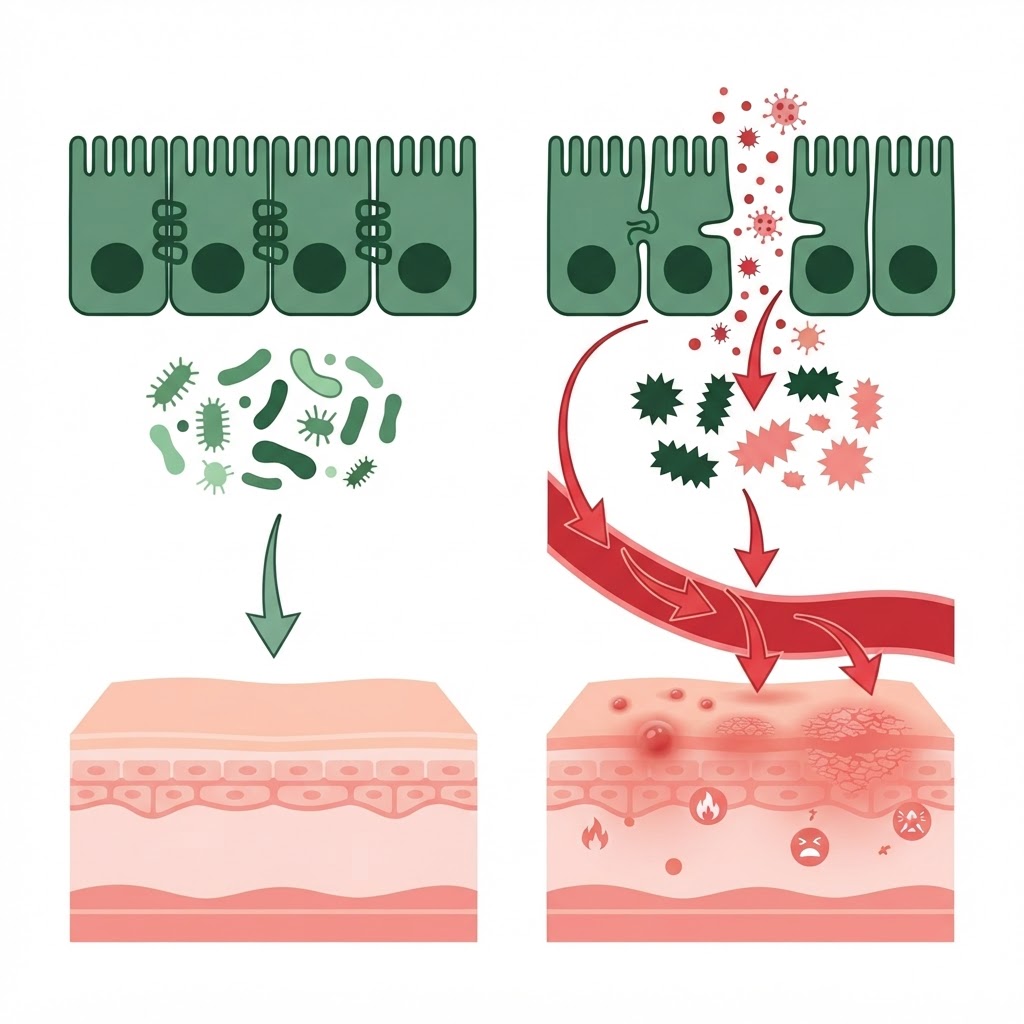
Your intestinal lining is, in healthy conditions, a remarkably selective barrier. It allows nutrients to pass into the bloodstream while keeping harmful substances — bacterial toxins, undigested food particles, pathogens — firmly on the other side. This barrier is maintained by tight junction proteins that essentially act as molecular gates.
When your gut microbiome is disrupted by factors like poor diet, chronic stress, antibiotic overuse, alcohol, or environmental toxins, these tight junctions can loosen. Suddenly, substances that have no business entering your bloodstream begin to leak through. Your immune system, encountering these foreign particles in the blood, mounts an inflammatory response.
How Leaky Gut Shows Up on Your Skin
This systemic inflammation doesn't stay contained to the gut. It travels — and for many women, the skin becomes a key battleground:
- Acne: Lipopolysaccharides (LPS) — inflammatory molecules from the outer membrane of certain bacteria — can leak into the bloodstream and trigger sebaceous gland activity, excess sebum production, and the kind of deep, cystic breakouts that no topical treatment can adequately address.
- Eczema (Atopic Dermatitis): Research published in the Journal of Allergy and Clinical Immunology has demonstrated that infants and adults with eczema show significantly reduced gut microbiome diversity compared to those with healthy skin. Disrupted gut barriers allow allergens to sensitise the immune system, leading to the characteristic hypersensitive inflammatory response seen in eczema.
- Rosacea: Interestingly, studies have found that patients with rosacea have significantly higher rates of small intestinal bacterial overgrowth (SIBO), suggesting that gut dysbiosis may be a root cause rather than a coincidence.
A landmark 2020 study published on PubMed confirmed the association between gut permeability markers and inflammatory skin conditions, reinforcing that healing the gut lining is a meaningful therapeutic target for dermatological health.
3. The Microbiome and Acne: What the Science Actually Says
Acne is the world's most common skin condition, affecting an estimated 85% of people at some point in their lives — but it is far from a teenage problem. Adult acne, particularly in women, is surging, and its root causes are multifactorial.
For decades, the conversation around acne focused almost exclusively on the skin microbiome — specifically the bacterium Cutibacterium acnes (formerly Propionibacterium acnes). But a more sophisticated picture has emerged: the gut microbiome shapes the conditions that allow inflammatory acne to thrive or subside.
Key Research Findings
- A study in Gut Pathogens found that acne patients showed significantly lower levels of Lactobacillus and Bifidobacterium species in their gut compared to healthy controls — two of the most well-studied and beneficial probiotic genera.
- Research from the National Institutes of Health has highlighted the role of gut-derived androgens in sebum production. A dysbiotic gut can increase the bioavailability of testosterone and other androgens, directly fuelling oil overproduction and pore-clogging.
- Probiotic supplementation with Lactobacillus acidophilus and Lactobacillus bulgaricus has been shown to reduce inflammatory acne lesion counts by up to 32% in 12 weeks when used alongside standard treatment.
- The gut microbiome influences insulin-like growth factor 1 (IGF-1) levels, a hormone strongly associated with acne severity. A healthier microbiome correlates with better IGF-1 regulation.
The Dairy and Sugar Connection — Explained by Your Gut
You may have noticed that dairy or high-sugar foods worsen your skin. This isn't coincidence. These foods alter gut microbiome composition rapidly, feeding opportunistic bacteria while depleting beneficial strains. Dairy contains bioactive hormones and leucine that spike IGF-1. Refined sugars cause blood glucose surges that promote insulin-driven androgen production. Your gut is the intermediary in all of these processes.
4. Eczema, the Immune System, and Your Gut Garden
Eczema (atopic dermatitis) is fundamentally an immune system disorder — and as we've established, your immune system lives largely in your gut. This makes the gut-skin connection particularly critical for the estimated 31 million Americans living with eczema.
The Early-Life Microbiome and Eczema Risk
Some of the most compelling evidence for the gut-skin axis comes from early-life microbiome research. Studies consistently show that:
- Babies born via caesarean section (who miss exposure to vaginal microbiome bacteria) have significantly higher rates of eczema and allergic disease in childhood.
- Formula-fed infants show different microbiome profiles from breastfed babies and have higher eczema incidence.
- Probiotic supplementation during pregnancy and early infancy has been shown to reduce eczema risk by up to 29%, according to a meta-analysis published in the British Medical Journal.
For adult women with eczema, the implications are equally important. Gut dysbiosis sustains the Th2-skewed immune response that characterises atopic dermatitis — essentially keeping your immune system in a chronic state of hypersensitivity. Rebalancing the gut microbiome helps shift this immune bias back toward balance, reducing the frequency and severity of flares.
Specific Probiotic Strains That Matter for Eczema
Not all probiotics are created equal, and this is especially true for eczema. Research has identified specific strains with meaningful clinical evidence:
- Lactobacillus rhamnosus GG: One of the most studied strains for atopic dermatitis; shown to reduce severity scores in multiple randomised controlled trials.
- Bifidobacterium longum: Reduces skin sensitivity and transepidermal water loss (TEWL) — the characteristic dryness of eczema-prone skin.
- Lactobacillus plantarum: Demonstrates barrier-strengthening effects both in the gut and on the skin, reducing inflammatory cytokine production.
All three of these evidence-based strains are included in the Her-Biotics Original formula, alongside 13 additional complementary strains — because skin health, like gut health, requires community, not single agents.
5. Probiotics for Skin: How to Choose What Actually Works
The supplement aisle is saturated with probiotic products making bold promises. As a physician, I feel a professional obligation to be honest with you: most probiotic supplements fail before they even reach your gut.
Here's the critical problem that the industry rarely discusses openly: probiotic bacteria are living organisms, and they are extraordinarily vulnerable to heat, moisture, stomach acid, and bile salts. Studies have shown that standard probiotic capsules can lose up to 99% of their viable bacteria by the time they reach the colon — which is precisely where they need to be active.
Why Delivery Technology Is Non-Negotiable
This is why I founded Her-Biotics on the principle that efficacy begins with delivery. Our patented SCO2 (supercritical carbon dioxide) microencapsulation technology uses pressurised carbon dioxide — a food-safe, solvent-free process — to create a protective shell around each probiotic strain at the molecular level.
The result?
- 1,000× more viable probiotics delivered to the gut compared to standard unencapsulated supplements
- Full protection through stomach acid and bile salt environments
- Guaranteed survival until the bacteria reach the lower gastrointestinal tract where they colonise and function
- No refrigeration required, without compromising potency
This isn't marketing language — it's verified through independent third-party testing using simulated gastrointestinal conditions. You can review the full technical data on our Science Page.
What to Look for in a Probiotic for Skin Health
Whether you're choosing Her-Biotics or evaluating any other supplement, here's your clinical checklist:
- Multi-strain formula — Diversity of strains matters for microbiome resilience
- Clinically studied strains — Look for specific strain designations (e.g., L. rhamnosus GG, not just "Lactobacillus")
- Survivability guarantee — Ask about delivery technology and independent testing
- CFU count at expiry — Not just at manufacture date; CFUs degrade over time in most standard capsules
- Complementary nutrients — Zinc, Vitamin C, and B-vitamins synergistically support both gut lining integrity and skin barrier function
- No unnecessary fillers — Maltodextrin, artificial colours, and certain preservatives can paradoxically disturb the microbiome
Her-Biotics Original meets all six of these criteria, combining our 16-strain probiotic blend with Vitamin C, Vitamin E, B-vitamins, and Zinc — nutrients with strong independent evidence for both gut barrier repair and skin health.
6. A Practical Protocol: Healing Your Gut for Clearer Skin
Understanding the science is empowering. Acting on it is transformative. Here is the protocol I recommend to my patients who are addressing skin conditions through the gut-skin axis:
Phase 1: Remove (Weeks 1–2)
Reduce inputs that disrupt the microbiome:
- Minimise refined sugar and ultra-processed foods
- Limit alcohol (significantly disrupts gut barrier integrity)
- Avoid unnecessary antibiotic use where possible (discuss with your doctor)
- Consider a temporary reduction in dairy if you suspect sensitivity
Phase 2: Restore (Weeks 2–12)
Actively rebuild microbiome diversity and gut barrier function:
- Begin a high-quality, multi-strain probiotic with proven survivability
- Increase prebiotic fibre intake: garlic, leeks, asparagus, green bananas, oats — these feed your beneficial bacteria
- Prioritise anti-inflammatory omega-3 fatty acids: fatty fish, flaxseed, walnuts
- Add fermented foods: plain kefir, kimchi, sauerkraut, unsweetened yoghurt
- Ensure adequate hydration (gut barrier function requires fluid balance)
Phase 3: Reinforce (Ongoing)
Protect the progress you've made:
- Manage chronic stress actively — cortisol is profoundly disruptive to gut barrier integrity
- Prioritise sleep: the gut microbiome follows circadian rhythms, and poor sleep degrades microbiome diversity
- Continue probiotic supplementation — studies show microbiome benefits persist and deepen with consistent, long-term use
- Track your skin alongside your gut symptoms to identify personal triggers
"Skin clarity isn't a cosmetic achievement — it's a metabolic one. It reflects the biochemical balance happening beneath the surface, particularly in the gut." — Dr. Chomba Chuma, MD
For women whose skin concerns are also tied to hormonal fluctuations — cyclical breakouts before your period, for instance — our Her-Biotics PMS Support formula adds Chasteberry, Magnesium Glycinate, and Vitamin B6 to the core probiotic base, targeting the hormonal-gut interface that drives so many women's skin struggles.
For a deeper library of evidence-based articles on gut health, hormones, and women's wellness, visit our Radiance Hub.
7. Real Timelines: What to Expect
One of the most important things I tell my patients is this: the gut-skin axis took time to become disrupted, and it takes time to heal. Realistic expectations are part of a sustainable approach.
- Weeks 1–2: You may notice digestive improvements first — less bloating, more regularity, reduced discomfort
- Weeks 3–6: Many women report reduced skin redness, fewer new breakouts, and improved skin texture
- Weeks 6–12: More significant reductions in acne lesion count; eczema flares becoming less frequent and less severe
- Months 3–6: Deeper microbiome diversity restoration; sustained skin clarity with reduced reliance on topical treatments
These timelines are consistent with what is observed in clinical probiotic research and are the ranges my patients most commonly report. Individual results vary based on baseline microbiome health, dietary habits, stress levels, and the severity of the skin condition.
Your Gut Is Your Skin's Most Powerful Ally
The skin you're living in right now is not a fixed reality. It is a dynamic, responsive organ that reflects your internal biochemistry in real time. When you tend to your gut — feeding it diverse, beneficial bacteria; protecting its lining; reducing the inflammatory load it carries — your skin responds with a clarity and resilience that no topical product alone can deliver.
This is not alternative medicine. This is physiology. It is immunology. It is the logical conclusion of decades of microbiome research, now translated into a practical, empowering approach to skin health for women.
If you're ready to begin addressing your skin from the inside out, I invite you to start with Her-Biotics Original — our foundational 16-strain formula, powered by patented SCO2 microencapsulation technology that guarantees 1,000× more viable probiotics actually reach your gut where they can do the work that matters. Formulated with Zinc, Vitamin C, Vitamin E, and B-vitamins to simultaneously support your gut lining and your skin barrier, it is the most scientifically complete first step you can take toward lasting skin clarity. Shop All Formulas and find the right Her-Biotics for where you are on your wellness journey today.
Dr. Chomba Chuma is a medical doctor, gut health specialist, and the Founder of Her-Biotics. She has dedicated her career to advancing women's health through the intersection of clinical medicine, microbiome science, and evidence-based supplementation. This article is for informational purposes and does not constitute individual medical advice. Consult your healthcare provider before beginning any new supplement regimen.
Enjoyed this? Get the next one first.
Science made simple, delivered to your inbox. No spam, unsubscribe anytime.