

If you've typed "best probiotic for women with bloating South Africa" into Google at 11pm, hand on your stomach, you're not alone. Pharmacy shelves are stacked with options, influencers swear by different brands, and the price tags vary wildly for what looks like the same white capsule.
This guide cuts through the noise. We'll walk through exactly what matters when choosing a probiotic for bloating, what to ignore, and why so many women say they've "tried everything" without real relief.
Why So Many Probiotics Fail at the One Job You Bought Them For
Bloating is one of the most common digestive complaints among South African women, often linked to stress, hormonal shifts, low fibre diets, and an imbalanced gut microbiome. The frustrating part is that many probiotics marketed for digestive support simply don't survive long enough to help.
Here's the uncomfortable truth: most oral probiotics are destroyed by stomach acid before they ever reach the intestines where they're needed. A capsule can contain billions of colony-forming units (CFUs) on the label, but if the bacteria die in transit, that number is meaningless.
This is why two women can take "the same type" of probiotic and get completely different results. The strain matters. The delivery technology matters. And the dose that actually survives matters more than the dose printed on the box.
"Different probiotic strains likely work in different ways, so the benefits seen with one strain may not apply to another, even within the same species." — National Center for Complementary and Integrative Health (NCCIH), Probiotics: What You Need To Know
If you've already tried the basics — water, movement, cutting fizzy drinks — and nothing stuck, our guide on how to debloat fast naturally covers science-backed quick fixes worth trying alongside any supplement.
What to Actually Look For in a Probiotic for Bloating
Not all probiotics are created equal, and for bloating specifically, there are a handful of non-negotiables.
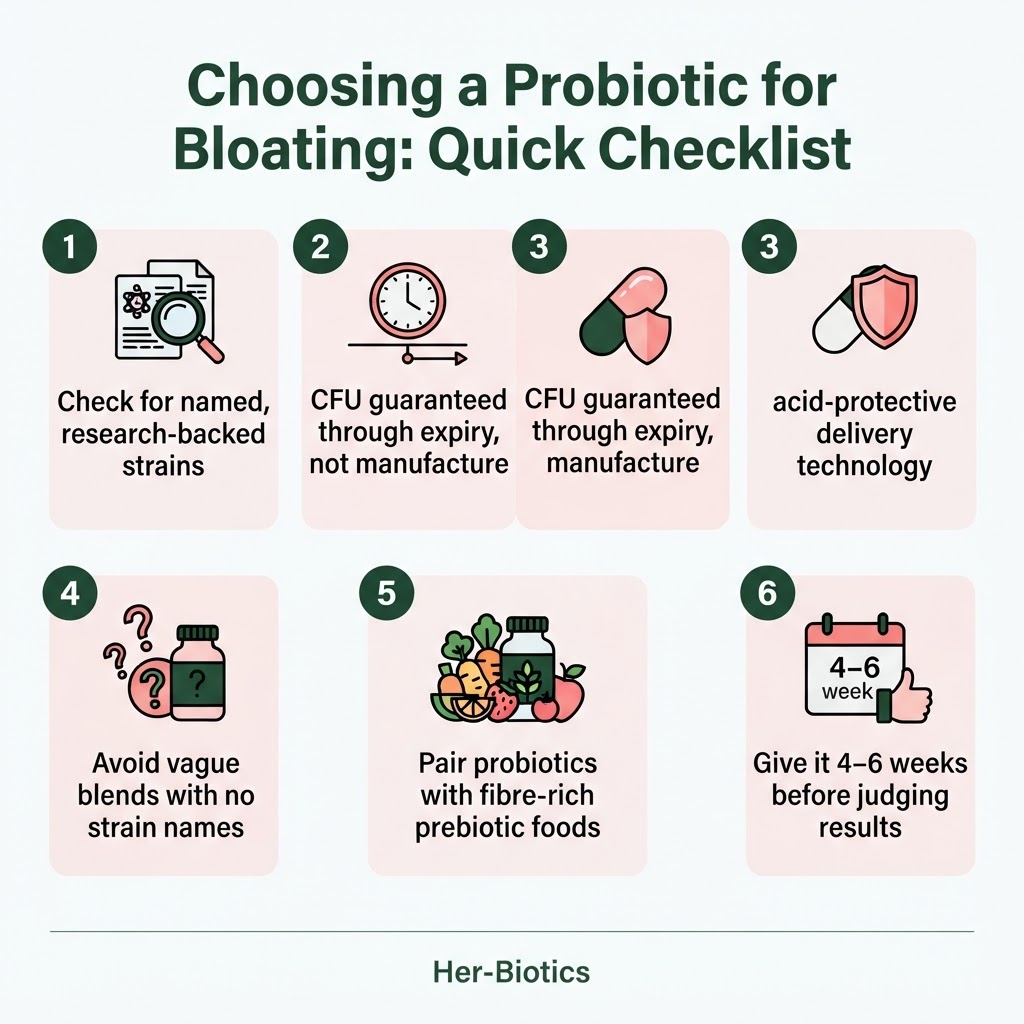
1. Named, Research-Backed Strains
The label should list specific strains, not just species. "Lactobacillus" tells you very little. "Lactobacillus plantarum 299v" tells you a lot, because that exact strain has published research behind it.
A clinical trial on Lactobacillus plantarum 299v found meaningful improvements in IBS-related bloating and abdominal pain scores over several weeks of use.
"Lactobacillus plantarum 299v significantly improved abdominal pain and bloating severity scores compared with placebo." — World Journal of Gastroenterology (2012), pubmed.ncbi.nlm.nih.gov/22013381
For a deeper breakdown of which strains are worth paying for, see our guide on best probiotic strains for women.
2. A CFU Count That Reflects What Survives, Not Just What's Added
Many labels show the CFU count at the time of manufacturing, not at the time you swallow it. By the time a standard capsule sits in a hot delivery truck or on a shelf for six months, a large percentage of those bacteria may already be inactive.
Look for brands that disclose:
- CFU count guaranteed through expiry, not just manufacture
- How the product is protected from heat, moisture and stomach acid
- Third-party testing or manufacturing transparency
3. A Delivery System Built for the Human Gut
This is the single biggest differentiator between probiotics that "do nothing" and probiotics women actually notice. Standard capsules dissolve in the stomach, exposing the bacteria to acid levels most strains simply can't survive.
Our detailed explainer on SCO2 microencapsulation covers exactly how this type of protective technology is designed to shield live cultures until they reach the intestines.
4. Formulated With Women's Physiology in Mind
Women's gut microbiomes interact closely with hormones, the menstrual cycle, and oestrogen metabolism. A probiotic formulated for women typically accounts for this relationship, rather than using a generic, one-size-fits-all blend.
For more on this connection, read the hidden communication system running your body.
Red Flags to Watch Out For on South African Shelves
Before you buy, scan the label for these warning signs:
- No named strains — just "probiotic blend" with no species or strain ID
- CFU count without a guarantee date — meaningless if it's not backed through expiry
- No mention of delivery/protection technology — a red flag for survival through stomach acid
- Suspiciously cheap pricing — quality encapsulation and strain sourcing cost money
- Vague claims with no research citations — be wary of anything promising to "cure" or "eliminate" bloating overnight; genuine products talk about supporting digestive comfort, not guaranteeing it
It's also worth being cautious of counterfeit or expired stock sold through informal online marketplaces. If you want to confirm you're getting an authentic, properly stored product, our guide on where to buy Her-Biotics in South Africa is a useful reference point even if you end up choosing a different brand.
How to Take a Probiotic So It Actually Works
Even the best-formulated probiotic needs the right conditions to do its job well.
Timing
- Take it consistently, at roughly the same time each day
- Many women find taking it with a meal containing some fat improves comfort
- Give it 4–6 weeks before judging results — the microbiome shifts gradually, not overnight
Pair It With Fibre and Prebiotics
Probiotics are the "seeds"; prebiotic fibre is the "fertiliser." Without enough fibre from food, even good bacteria have little to feed on. Our guide to prebiotic foods that supercharge your probiotic supplement is a simple next step once you've chosen a probiotic.
Track Your Symptoms
Keep a simple note on your phone:
- Bloating severity (1–10) each evening
- Any trigger foods eaten that day
- Stress or sleep quality
This makes it much easier to tell whether a product is genuinely helping or whether something else — like stress or sleep — is the bigger driver. If cortisol feels like part of your picture, stress, cortisol and the gut is worth a read too.
Where Her-Biotics Fits Into This Picture
Her-Biotics was built specifically around the problems outlined above: strain selection, survival, and formulation for women's physiology.
Here's what that looks like in practice:
- Targeted, named strains selected with women's digestive and hormonal health in mind — detailed in our ingredients and strains breakdown
- Patented SCO2 microencapsulation, designed to protect live cultures through stomach acid so more of them are positioned to reach the gut
- CFU guaranteed through expiry, not just at the point of manufacture
- Formulated as part of a South African-available range, with guidance on verified stockists
"Probiotics may help restore the natural balance of bacteria in the gut and have been studied for a possible role in digestive comfort." — Mayo Clinic, Probiotics: What You Need to Know (mayoclinic.org)
Real customer experiences — including what did and didn't change for them — are collected honestly (with the research behind each claim) in Her-Biotics Probiotic Reviews: What Real Women Say.
It's worth noting: probiotics are a support tool, not a replacement for medical care. If bloating is severe, persistent, or paired with other symptoms like unexplained weight changes or blood in stool, please speak to a doctor or gastroenterologist rather than relying on supplements alone.
Your Simplest Next Step
You don't need to overhaul your entire diet overnight or try five supplements at once. The simplest first step is choosing one well-formulated, strain-specific probiotic and giving it a fair 4–6 week trial alongside basic fibre and hydration habits.
If daily bloating, sluggish digestion, and low energy sound familiar, Her-Biotics Original was formulated with exactly this starting point in mind — everyday gut support, immune health, and skin clarity, built on SCO2 microencapsulation technology.
Browse the full range at the Her-Biotics store, and subscribe to the Her-Biotics newsletter below for ongoing, science-backed gut health guidance delivered straight to your inbox.
Enjoyed this? Get the next one first.
Science made simple, delivered to your inbox. No spam, unsubscribe anytime.