

If you've ever wondered why your hormones feel like they have a mind of their own, part of the answer may be living in your gut. Trillions of bacteria down there don't just help you digest lunch — they also have a direct hand in how your body processes and recycles oestrogen. This specialised community even has its own name: the estrobolome.
Understanding how gut bacteria affect oestrogen in women isn't just interesting trivia. It can reshape how you think about skin flare-ups, stubborn bloating, mood dips, and energy crashes that seem to arrive right on cue with your cycle.
Meet the Estrobolome: Your Gut's Hidden Hormone Control Center
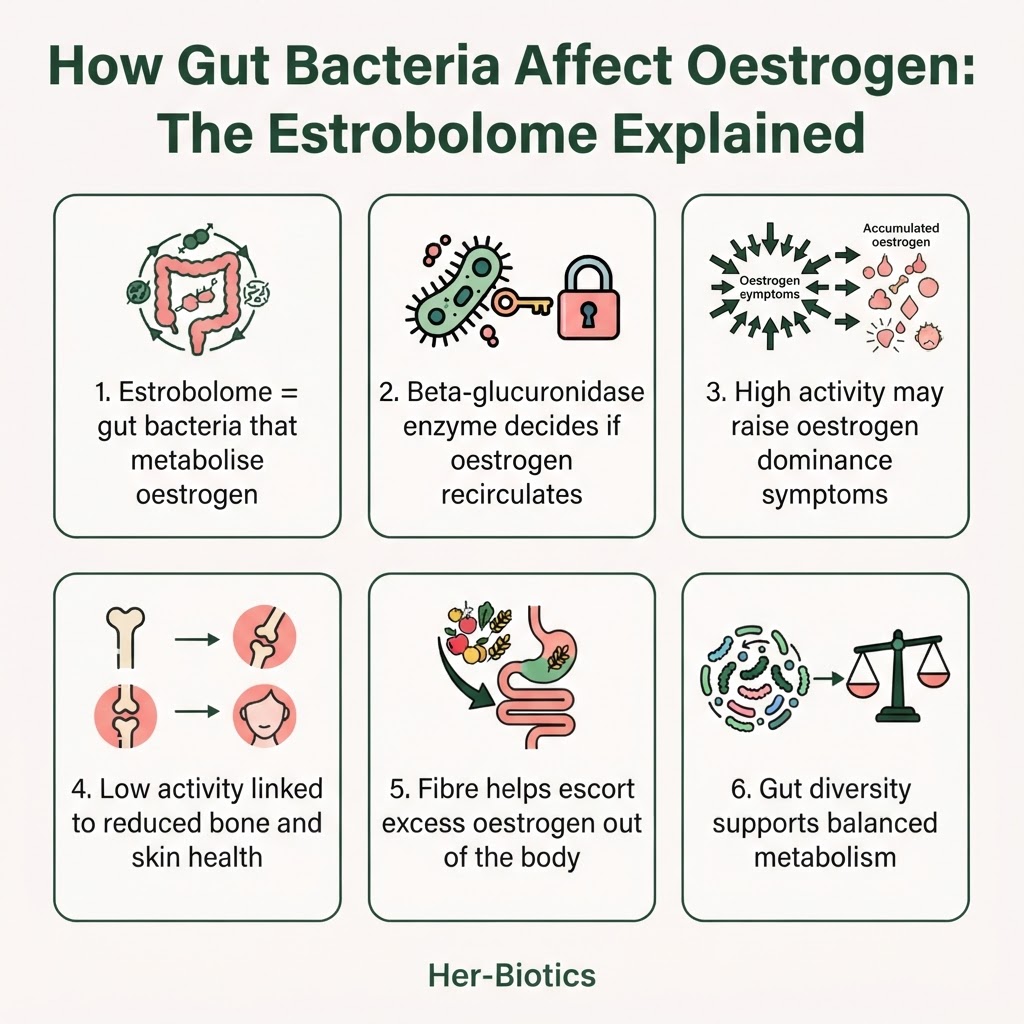
The estrobolome is the collection of gut bacteria and their genes that are capable of metabolising oestrogen. Think of it as a small but mighty department inside your microbiome, dedicated entirely to hormone housekeeping.
Here's the basic flow:
- Your liver processes oestrogen and tags it for removal, packaging it with a molecule called glucuronic acid.
- This packaged oestrogen travels to the gut to be excreted in stool.
- Certain gut bacteria can "unwrap" this package using an enzyme, releasing active oestrogen back into circulation.
"The gut microbiome's capacity to metabolise oestrogens may influence oestrogen-related physiology and disease risk in women." — Kwa et al., Journal of the National Cancer Institute (2016)
When this system works smoothly, your body keeps a fairly steady, healthy rhythm of oestrogen circulating, clearing, and recycling. When it doesn't, things can feel — and show up — very differently.
We've covered the broader picture of this communication system in Gut and Hormones Connection in Women Explained, but here we're zooming in specifically on oestrogen's gut-powered journey.
The Enzyme That Decides Whether Oestrogen Stays or Goes
The real star (or troublemaker) of this story is an enzyme called beta-glucuronidase, produced by various gut bacteria.
What beta-glucuronidase actually does
This enzyme breaks the bond between oestrogen and the glucuronic acid tag your liver attached. Once that bond breaks:
- The oestrogen becomes "free" and biologically active again.
- Instead of leaving your body, it gets reabsorbed back into the bloodstream.
- This process is called enterohepatic recirculation.
A little of this recycling is completely normal and even useful. But when beta-glucuronidase activity runs too high — often due to an imbalanced or less diverse microbiome — more oestrogen gets reabsorbed than your body may need.
"Diversity and composition of the gut microbiota may be an important modulator of circulating oestrogen levels." — Baker et al., Maturitas (2017)
On the flip side, if beta-glucuronidase activity is too low, more oestrogen may be excreted than ideal, which has its own downstream effects on mood, skin, and bone health.
When the Estrobolome Falls Out of Balance
There isn't one single "bad" outcome here — imbalance can tip in either direction, and both matter.
Too much recirculation: oestrogen dominance patterns
When bacterial beta-glucuronidase activity is elevated, oestrogen may be reabsorbed more than it should be, contributing to what's often loosely referred to as oestrogen dominance relative to progesterone. This pattern is commonly associated with:
- Heavier or more painful periods
- Breast tenderness
- Fluid retention and bloating
- Increased PMS-type mood symptoms
If this sounds familiar, our piece on PMS and the Microbiome: How Gut Health Governs Your Cycle explores the cycle-specific side of this in more depth.
Too little recirculation: lower circulating oestrogen
A less diverse microbiome with lower beta-glucuronidase activity may mean more oestrogen gets excreted rather than recycled. Over time, this is associated with lower circulating oestrogen levels, which has been linked in research to:
- Reduced bone mineral density
- Drier skin and reduced elasticity
- More pronounced menopausal symptoms
This is especially relevant during perimenopause and menopause, a topic we go into fully in Menopause and the Microbiome: How to Reduce Hot Flashes Naturally.
The takeaway: it's not about having "more" or "less" gut bacteria — it's about having the right diversity so your estrobolome can keep oestrogen levels in a healthy, balanced range.
How an Imbalanced Estrobolome Shows Up in Daily Life
Hormone chemistry can feel abstract until you connect it to things you actually notice day to day.
Skin
Oestrogen supports collagen production and skin hydration. Fluctuations driven by gut imbalance may show up as breakouts, dullness, or unexpected dryness. We explore this further in The Gut-Skin Connection: How to Clear Acne and Eczema from the Inside Out.
Mood and energy
Oestrogen interacts with serotonin pathways, so swings in circulating levels may be associated with mood changes, irritability, or low energy — patterns many women notice shifting across their cycle.
Bloating and digestion
Oestrogen also influences gut motility and water retention, which is part of why hormonal bloating feels so different from food-related bloating. If this is a daily struggle, The Best Probiotic for Women With Bloating in South Africa and How to Debloat Fast Naturally offer practical, science-backed starting points.
Cycle regularity
Because the estrobolome helps regulate circulating oestrogen, an imbalanced gut may contribute to irregular or unpredictable cycles over time, alongside many other factors.
The Liver-Gut Partnership You've Never Heard Of
Your liver and gut aren't working independently — they're in constant conversation.
Phase one and phase two detoxification
Your liver processes oestrogen in two broad steps:
- Phase one converts oestrogen into intermediate metabolites.
- Phase two attaches molecules (like glucuronic acid) to make those metabolites water-soluble and ready for excretion.
Your gut bacteria essentially get the final say on step two. If the gut environment favours high beta-glucuronidase activity, some of that carefully packaged oestrogen gets "unpacked" and sent back into circulation instead of leaving the body.
"Hormone metabolism reflects an integrated system between hepatic detoxification pathways and the gut microbial community." — National Institutes of Health, PMC review on the gut-liver-hormone axis
This is one reason gut-focused support can be a meaningful piece of the hormone puzzle — even though it works quietly, behind the scenes.
Feeding Your Estrobolome: Food, Fibre and Probiotics
The good news: your estrobolome responds to what you feed it.
Fibre is non-negotiable
Dietary fibre binds to excess oestrogen in the gut and helps escort it out of the body before bacterial enzymes get the chance to "unpack" it. The Mayo Clinic recommends most women aim for roughly 25g of fibre daily — a target many of us fall short of.
Good sources include:
- Ground flaxseed and chia seeds
- Leafy greens and cruciferous vegetables (broccoli, cauliflower, kale)
- Legumes and whole grains
- Berries and pears
Phytoestrogen-rich foods
Plant compounds like lignans (in flaxseed) and isoflavones (in soy, chickpeas) can gently interact with oestrogen receptors and may support more balanced circulating levels.
Diversity over perfection
A varied diet rich in different plant fibres feeds a wider range of beneficial bacteria, which supports a more balanced estrobolome overall. Our guide on Prebiotic Foods That Supercharge Your Probiotic Supplement breaks this down further.
Targeted probiotic strains
Certain probiotic strains have been studied for their role in supporting a healthy gut environment, which may in turn support more balanced beta-glucuronidase activity. For a deeper dive into which strains matter most, see Best Probiotic Strains for Women and Her-Biotics Ingredients Strains.
Of course, a probiotic is only useful if the bacteria actually survive the trip to your gut — something we explain in detail in SCO2 Microencapsulation: The Science Behind 1000× More Probiotics.
Your Next Step Toward Hormone-Friendly Gut Health
You don't need to overhaul everything overnight. Supporting your estrobolome can start small:
- Add one extra fibre-rich food to your next meal
- Prioritise consistent sleep, which also affects hormone metabolism (more in Sleep and Gut Health)
- Consider a daily probiotic formulated for women's gut-hormone needs
This is exactly why we created Her-Biotics Original — a daily probiotic using patented SCO2 microencapsulation so more live cultures survive stomach acid and actually reach your gut, where your estrobolome needs them most. Explore Her-Biotics Original here, or browse the full Her-Biotics range to find the formula that fits your stage of life.
Real results matter too — see what women are actually experiencing in Her-Biotics Probiotic Reviews, or find out where to buy Her-Biotics in South Africa.
As always, gut-hormone balance is highly individual. If you're experiencing persistent symptoms, please consult your doctor or a registered healthcare provider for personalised guidance — this article is educational and isn't a substitute for medical advice.
Ready to support your gut-hormone connection daily? Shop Her-Biotics Original and don't forget to subscribe to the Her-Biotics newsletter below for more science-backed guidance on gut health, hormones, and feeling like yourself again.
Enjoyed this? Get the next one first.
Science made simple, delivered to your inbox. No spam, unsubscribe anytime.